

Top Myths of Customer Loyalty Programs

Walk into any retail conference, and you’ll hear one topic everywhere: loyalty programs—points, perks, VIP tiers, the works. And for good reason. And for good reason. When done right, customer loyalty programs in retail drive repeat visits, increase basket size, and turn occasional shoppers into regulars.
But here’s the problem.
For every success story, there are a dozen retailers who tried loyalty and walked away disappointed. “It didn’t move the needle (and yet for a few it moved the entire weighing scale).” “Nobody signed up.” “Too much work for too little return.”
Sound familiar?
The issue isn’t loyalty programs themselves. It’s the myths about loyalty programs that keep circling the industry like bad advice from a well-meaning uncle. These misconceptions lead retailers down the wrong path—overcomplicating, under-delivering, and ultimately abandoning something that could in fact grow their business.
This article is for retailers who want the Truth. No hype. No theory. Just a straight look at what customer loyalty programs can and cannot do, and why most of what you’ve heard might be holding you back.
The Perception vs. Reality Gap

Myth #1: Loyalty Programs Are Just About Discounts
A customer walks in, flashes their loyalty card, and you think, “Here comes another discount.”
Most retailers default to this because it’s easy. Slice 10% off, punch a card, and call it a day. And for a while, it works. Customers show up. Sales tick up. Everyone’s happy.
But here is what happens next.
1) Why retailers default to discount-heavy programs
Because discounts are measurable. You can track them. You can put them in a flyer. And frankly, it’s what customers ask for. “Just give me a deal.” So, we oblige. We build entire customer loyalty programs in retail around price cuts and wonder why margins keep shrinking.
2) The risks of over-reliance on discounts
Three things happen when discounts become your program’s backbone:
- Margin erosion. Every sale costs you more. That 10% off adds up fast.
- Deal-seeking behavior. You attract shoppers who leave the moment your competitor runs a better promo.
- Short-term loyalty. They’re loyal to the discount, not your store. There’s a difference.
This is one of the most damaging myths about loyalty programs—that discounts are the only thing customers want. They’re not. They just haven’t been shown anything better.
3) Broader loyalty value drivers
Real loyalty runs on four things price cuts cannot buy:
3.1) Exclusive access. Let members buy the limited drop before anyone else.
3.2) Recognition. Greet them by name. Remember their usual. Costs nothing. Builds everything.
3.3) Convenience. Saved payment details. Faster checkout. Less friction.
3.4) Emotional connection. Birthday rewards. “We missed you” notes. Feeling like a regular, not a number.
4) Examples:
Early access – A bottle shop gives loyalty members first crack at allocated bourbon releases. No discount. Just first in line.
Members-only perks – A pet store offers free nail trims—a $15 value—to active members.
Personalized experience: – A coffee shop sends a “your usual is waiting” push notification when a member walks nearby.
5) The bottom line
Discounts have a job. They move slow inventory. They reward frequency. They welcome new members.
But if your customer loyalty programs are built entirely on price cuts, you’re not building loyalty. You’re training shoppers to wait for deals.
Discounts should support your program. They should never define it.
Myth #2: Once Customers Join, They’re Loyal
You spent weeks promoting the sign-up. Trainers mentioned it at every checkout. Finally, the numbers roll in—500 new members. Feels good, right?
Here’s the uncomfortable truth: you just recruited 500 people who want something from you. You haven’t earned anything yet.
1) Sign-ups ≠ engagement ≠ loyalty
Think of it like dating. A phone number isn’t a relationship. And a loyalty sign-up? It’s just permission to start a conversation.
According to a Code Broker statistic cited by Forbes, 65% of consumers actively engage with less than half of the loyalty programs they belong to.
The real work begins after they join. Yet too many retailers treat the sign-up as the finish line.
2) The common mistake: measuring members, not behavior
“Look at our numbers! We have 5,000 loyalty members!”
Heard this before? Maybe you even said it yourself. But here is the question nobody asks: how many of those 5,000 shopped with you last month? Last week? Ever?
Measuring program success by sign-ups alone is like judging a restaurant by how many people walk through the door—while ignoring how many eat and come back. It’s one of the hollowest myths about loyalty programs in retail.
3) What real loyalty looks like
Stop counting members. Start watching behavior. Real loyalty shows up in three places:
3.1) Repeat purchase frequency. Do they come back? Not once. Not twice. Regularly. A loyalty member who shops monthly is worth more than five who signed up and vanished.
3.2) Share of wallet. When they need what you sell, do they come to you? Or do they split their spend across you and two competitors? True loyalty means you get first dibs on their budget.
3.3) Engagement across channels. Do they open your emails? Redeem your offers? Follow your social? Silence across channels usually means indifference.
4) Sign-ups are the start, not the finish
Here is what separates successful customer loyalty programs in retail from the ones that fizzle out:
The winners keep nurturing. They welcome new members with a clear next step. They send offers based on actual purchase data. They notice when someone goes quiet and try to win them back.
The losers? They throw a punch card at people and wonder why nobody uses it.
5) A word about “inactive loyalty databases”
What’s a database full of inactive members? A graveyard.
It costs money to maintain, it throws off your metrics, and worst of all—it gives you a false sense of security. “We have thousands of members” doesn’t mean much if most of them haven’t stepped foot in your store in years.
Clean your lists. Focus on the members who actually engage. And stop assuming that sign-ups automatically equal loyalty.
They don’t. They’re just the door. What happens next is up to you.

Myth #3: All Customers Want the Same Rewards
Look at your customer list. Really look.
There’s the contractor who stops in every morning for coffee and a pack of smokes. The mom who buys diapers and the occasional six-pack. The weekend entertainer dropping serious money on craft beer and premium liquor. The bargain hunter who only goes for the rock-bottom deals.
Now ask yourself: why would they all want the same reward?
1) Why one-size-fits-all rewards fail
Simple. Because your customers aren’t one-size-fits-all people.
Yet most customer loyalty programs in retail treat them that way. One program. One set of rewards. One message to everyone. It’s lazy retail, and customers notice.
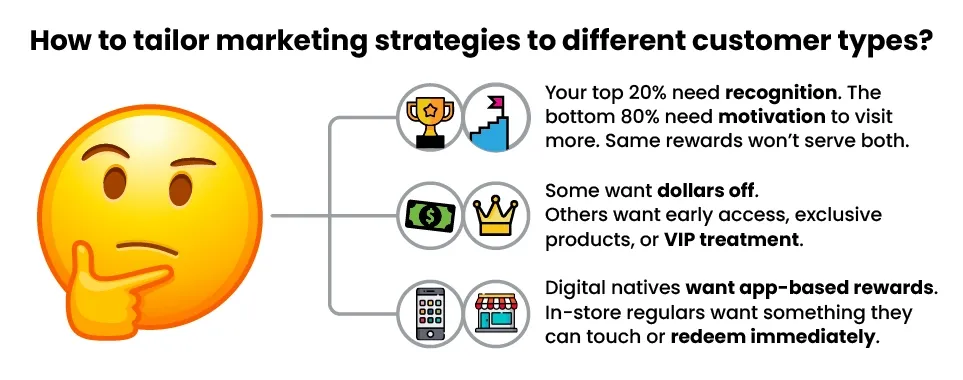
The result? Your offers feel generic. Your best customers feel overlooked. And your occasional buyers never feel motivated to level up. If everyone gets the same reward, the program matters to no one.
2) Every customer is different—treat them that way.
Break down your audience. You’ll find distinct groups staring back.
Look at the below visual for a customer type and what they value:
3) Personalization changes the game
Here is where you leave the myths about loyalty programs behind and start building one that works.
3.1) Tier-based rewards. Let customers graduate to better perks. Bronze gets 1% back. Silver gets 2% plus a birthday reward. Gold gets all that plus early access to sales. Now high-value customers feel seen, and occasional buyers have a ladder to climb.
3.2) Behavioral triggers. Send offers based on what people do. Coffee drinkers get coffee coupons. Beer buyers get beer deals. This isn’t complicated—it’s just paying attention.
3.3) Preference-driven incentives. Let members tell you what they want. “I prefer wine over spirits.” Great. Now you can send relevant offers instead of blasting everyone with discounts on whiskey they’ll never buy.
4) The magic of personalization: higher value, same cost
Here’s the part most retailers miss.
A generic $5 off coupon feels like… $5 off. But a personalized “we saved your favorite wine” alert? That feels like you know them. A birthday reward? That feels like you remembered.
The perceived value goes up. The cost to you? Exactly the same.
You’re not spending more. You’re just spending smarter. And that is how modern customer loyalty programs in retail stop being expense lines and start becoming growth drivers.
Same budget. Better results. Just by treating different customers… differently.
Myth #4: Loyalty Programs Are Too Expensive to Maintain
You’ve looked at loyalty software prices. You’ve calculated staff time for sign-ups. You’ve wondered if the whole thing is just another monthly bill that bleeds profit instead of building it.
Fair concern. Retail margins are thin. Every expense gets side-eyed.
But here is what most cost conversations miss.
1) The concern is real
Yes, loyalty programs cost money. Software fees. Integration time. Marketing execution. Ongoing management. Nobody is saying it’s free.
And yes, there are plenty of programs that waste money while showing little to no payoff. You’ve probably seen them. Points that never get redeemed. Offers that destroy margins. Databases full of inactive names.
2) Cheap programs vs. smart programs
There is a difference between a program that costs and a program that pays.

The first one is expensive. The second one is an investment.
3) The hidden costs of doing nothing
Here is what doesn’t show up on a spreadsheet but drains your bank account anyway:
3.1) High acquisition spend. You keep paying to bring new people in while old ones drift away. Customer replacement is the most expensive game in retail.
3.2) Low repeat rates. First-time buyers never become second-time buyers because you have no system to bring them back. Every sale starts from zero.
3.3) Weak customer insights. You’re flying blind. No data on who buys what, when they buy, or why they stop. So, you guess. And guessing costs money.
These are the real expenses. A loyalty program isn’t a cost—it’s a cure for these costs.
4) What smart loyalty programs do
When built right, customer loyalty programs in retail become efficiency machines:
4.1) Improve retention. Always keep a customer; it costs less than finding a new one. A small retention increase can boost profit by a good margin. That’s not theory—that’s math.
4.2) Increase customer lifetime value. A loyalty member who stays three years is worth exponentially more than a first-timer who never returns. You’re not spending on rewards. You’re investing in long-term revenue.
4.3) Automatically segment customers. You don’t need a data scientist. A good system tracks purchase patterns and groups customers by interest automatically. Beer buyers get beer offers. Dog owners get dog offers. No extra work. Just better targeting.
5) Cost-efficiency through automation
This is where the myths about loyalty programs collide with reality.
Modern systems do the heavy lifting for you:
- Automated welcome emails go out the moment someone signs up.
- Birthday rewards trigger without you touching a calendar.
- “We miss you” offers fire when a customer goes quiet.
- Redemption happens at the POS with one scan—no paper, no manual entry.
You’re not hiring staff to run the program. You’re not printing and punching and tracking by hand. The software runs itself. You just reap the results.
So, is a loyalty program expensive?
Only if it’s built the wrong way. Done right, the question isn’t “Can I afford it?” It’s “Can I afford not to?”
Myth #5: Points-Based Programs Are Enough
Let’s start with the obvious: points work. They’re familiar. Customers understand them. Spend a dollar, get a point. Accumulate enough, get something back. Simple math.
But here’s the question nobody asks: Is simple math enough to build loyalty?
1) Points are popular for a reason
They’re easy to explain. Easy to track. Easy for customers to grasp. Most customer loyalty programs in retail start here because it’s the path of least resistance.
And for some retailers, that’s where they stop.
2) Why points alone fall short
Points create transactions. They don’t create feelings. And feelings are what keep customers coming back.
3) What points need to succeed
The programs that win don’t abandon points. They just stop relying on them exclusively.
3.1) Instant rewards. A small, immediate payoff alongside the long-term points goal. “Spend $10 today, get a free coffee right now and points toward next month.”
3.2) Non-monetary benefits. Gift wrapping. Priority service. Exclusive access to events. Things money can’t buy, but loyalty can.
3.3) Gamification. Badges for trying new categories. Stretch goals for visiting during slow hours. Leaderboards for top spenders. Make it fun, not just transactional.
3.4) Experiential rewards. Dinner with the winemaker. First look at new inventory. A “member for a day” experience behind the counter. Stuff points alone can’t capture.
4) Blend points with feeling
The best customer loyalty programs in retail do both.
Points handle the math. Experiences handle the memories. Recognition handles the emotions.
A customer who saves up points for a discount is engaged. A customer who feels known, appreciated, and excited about what comes next? That customer is loyal.
5) The bottom line
Transactional loyalty gets you repeat business. Emotional loyalty gets you forgiveness when you mess up, word-of-mouth when you do well, and resistance when competitors come calling.
Points bring customers in. Experiences keep them loyal.
Don’t let one of the oldest myths about loyalty programs convince you that a spreadsheet is enough. It’s not. Loyalty lives in how you make people feel, not just how you calculate their balance.
Myth #6: Loyalty Programs Work the Same Across All Retail Channels
Your customer woke up this morning. Scrolled your app on the commute. Browsed your website at lunch. Walked into your store after work.
To them, this is one shopping day. One relationship with your brand.
Too many loyalty programs? Those are three separate experiences that don’t talk to each other.
1) How customers move
Modern shopping isn’t linear. It’s a mess—in a good way.
1.1) Online store. Researching products, checking prices, reading reviews.
1.2) Mobile app. Saving favorites, grabbing digital coupons, scanning for nearby deals.
1.3) Physical store. Touching products, asking staff, checking out in person.
Your customers cross these lines constantly. They expect you to keep up.
2) The channel-siloed mistake
Here’s where many customer loyalty programs in retail break down:
| Channel | Loyalty Experience | The Problem |
|---|---|---|
| In-store | Earn points with purchase | But the online cart doesn’t see in-store history |
| Mobile app | Exclusive app-only offers | But can’t redeem them in-store without showing a screen |
| Website | Browse and save items | But store staff can’t see what’s in their online wishlist |
3) What seamless loyalty requires
3.1) Unified customer profiles. One login. One history. Every channel updates the same record.
3.2) Consistent rewards across channels. Points earned online can be spent in-store. Offers clipped on mobile apply at the register. No exceptions.
3.3) Seamless earn-and-redeem experiences. Scan, tap, done. No explaining. No “let me check with my manager.”
4) Friction examples that kill loyalty

- A customer sees a “mobile exclusive” coupon, drives to your store, and the cashier says, “We don’t take those here.”
- A regular who always shops in-store signs up online, then wonders why her purchase history vanished.
- Points earned from a big online order don’t show up when she’s ready to redeem at the register.
Each one is a small betrayal. Enough of them, and she stops caring about your program entirely.
5) The right approach
Loyalty must be channel-agnostic. Customers shouldn’t have to think about where they are to access what they’ve earned.
But it should be experience aware. The app knows they browse at night. The store knows they buy in bulk on weekends. The system remembers—and rewards—the full picture, not just one channel.
This isn’t one of those technical myths about loyalty programs you can ignore. It’s the difference between a program that feels helpful and one that feels like homework.
Myth #7: Technology Alone Can Fix Loyalty
Walk into any retail tech conference. You’ll see them: platforms promising AI-powered everything. Predictive analytics. Automated journeys. Customer relationship management (CRM) magic in a box.
And yes, the tools are impressive. They can do things human teams never could at scale.
But here’s the catch.
1) Technology has a role—an important one
Nobody is saying otherwise. Modern customer loyalty programs in retail need good tech. CRM systems track behavior. AI predicts who might lapse. Platforms automate offers that would take hours to send manually.
These tools are powerful. They’re just not powerful enough to fix a broken strategy.
2) Technology enables. It doesn’t replace thinking.
A CRM doesn’t know your customers. It stores data about them. An AI doesn’t understand loyalty. It identifies patterns. A loyalty platform doesn’t build relationships. It facilitates them.
Confuse the tool with the solution, and you end up with expensive software doing nothing useful.
3) Common pitfalls

Both are expensive ways to learn that tech is not a shortcut.
4) What actually makes loyalty work
Before you buy another tool, get these things straight:
4.1) Clear loyalty objectives. What are you trying to achieve? Higher frequency? Bigger baskets? More referrals? Know the goal before you buy the gear.
4.2) Customer-centric program design. Build for how your actual customers shop. Not for what the software demo showed. Your customers don’t care about your platform’s features. They care about whether the program feels good to use.
4.3) Cross-team alignment. Marketing, operations, IT—they all need to row in the same direction. A loyalty program run by one department while others ignore it is a loyalty program destined for the graveyard.
5) The real role of technology
Think of tech as your best employee. It works 24/7. It never forgets. It processes faster than any human.
But it still needs direction. It still needs to know what “good” looks like. It still needs someone to say “That offer feels right” or “That email sounds too robotic.”
The best customer loyalty programs in retail use technology to execute. But they use humans to design, question, and refine.
Tech scales the work. It doesn’t replace the thinking.
The Bottom Line
One of the most expensive myths about loyalty programs is that software alone can save you. It can’t. The tool is only as good as the strategy behind it, the team running it, and the customers it serves.
Buy the tech. Just don’t let it drive.
Wrapping Up
The thing about loyalty programs is the small moments that have nothing to do with points and everything to do with being seen. Say “No” to shortcuts like punch cards, one-time discounts, or “buy 10 get 1 free” stamps.
Retailers who challenge the myths win.
While competitors chase deal-seekers with deeper discounts, you’ll be building relationships that discounts can’t touch. While others measure success by sign-up counts, you’ll watch actual behavior—frequency, share of wallet, lifetime value.
The customer who feels recognized doesn’t need a coupon to return. Build a program that delivers that.
Everything else is just noise.

FAQs
No. Discounts attract deal seekers. Real loyalty comes from recognition, exclusive access, and convenience. Loyal-n-Save helps you build programs that reward customers beyond the price tag—early access to products, member-only perks, and personalized experiences that discounts alone can't buy.
Not even close. Sign-ups are just permission to start a conversation. Real loyalty shows up in repeat purchases, how often and how much they buy from you, and ongoing engagement. LNS tracks these behaviors so you know which members are actually loyal—and which ones need nurturing.
Treating it as 'set it and forget it.' Too many retailers launch their programs—and then walk away. The best programs are constantly optimized—refining offers, cleaning inactive lists, and testing new reward types. LNS gives you the data to keep improving, not just monitoring.
Points aren't outdated. Relying on only points is. Modern programs blend points with instant rewards, experiential perks, and emotional recognition. Loyal-n-Save lets you layer multiple reward types so your program feels fresh, not like a spreadsheet.
It's everything. A generic offer to everyone is a relevant offer to no one. Personalization—sending the right reward to the right customer—increases redemption without increasing cost. LNS automatically segments customers by behavior so your offers actually match what they buy.
Posted on Mar 5, 2026

Danielle is a content writer at Loyal-n-Save. She specializes in writing about implementing loyalty solutions proven to help a company grow.
Content Writer