

How to Train Staff on a Loyalty Program (the Right Way)

What keeps loyalty program managers up at night? It’s not technology.
You can build the most sophisticated points engine. You can design rewards that would make a casino blush. You can integrate with every POS system known to humankind. And none of it matters one bit if the person behind the counter doesn’t mention it.
We’ve watched it happen more times than we can count. A customer walks in, spends $50, and walks out. The cashier had four opportunities to say “Hey, you could earn points on that” and said nothing. Not because they’re bad at their job. Because no one trained them.
The hard truth? Most loyalty programs don’t fail because of bad technology. They fail because of bad execution. At the front line. Where does it actually counts.
Why Staff Training Determines Loyalty Program Success
Here’s what your frontline employees control:
| What They Influence | Why It Matters |
|---|---|
| Enrollment rates | The sign-up happens at the register or not at all |
| Customer experience | A clumsy explanation feels like a sales pitch |
| Reward redemption accuracy | Wrong points = angry customer |
| Customer engagement | Enthusiastic staff create enthusiastic members |
The numbers support this. Harvard Business Review has reported that research shows just a 5% increase in customer retention can boost profits by roughly 25% to 95% because keeping existing customers is more cost‑effective and drives repeat purchases.
Now flip it. What happens when training is bad?
- Low Enrollment. The program exists on paper only.
- Customer Frustration. “You told me I’d get points. Where are they?”
- Revenue Leakage. You’re paying for software that isn’t delivering.
- Dead Points. Members earn tokens they never redeem, which means they’re not engaged.
The program becomes a cost center instead of a growth engine. And it’s not the employees’ fault. It’s yours.
Define Clear Loyalty Program Objectives Before Training
Before you train anyone, you need to know what you’re actually trying to achieve. This sounds obvious. You’d be shocked how many companies skip it.
A. Business Goals
Your training must ladder up to something measurable. Not “make customers happier.” Specific, trackable outcomes:
| Goal | Why It Matters |
|---|---|
| Boost customer sign-ups | More members = more data = more retention potential |
| Increase repeat purchase rate | The whole point of loyalty |
| Grow average order value (AOV) | Members should spend more per visit |
| Capture customer data | Email, phone, birthday—the fuel for personalization |
| Improve retention | Keep the customers you worked so hard to acquire |
| Maximize redemption rate | Engaged members redeem. Dead members don’t. |
If your training doesn’t connect to these numbers, it’s just words. Vague goals produce vague results. Period.
B. Employee-Level Expectations
Here’s where it gets personal. Your staff need to know: what does success look like for me today?
- Enrollment Target Per Shift. Not a vague “try to sign people up.” A number. “We need three sign-ups from you tonight.”
- Script Usage Expectations. “Use this exact opening line. We tested it. It works.”
- Accountability. Track it. Share it. Celebrate it.
Clarity is kindness. When people know exactly what’s expected, they can actually deliver.
C. What Staff Must Understand About the Loyalty Program
You can’t expect employees to explain something they don’t understand themselves.
Here’s the baseline knowledge they need:
Program Structure
- Enrollment: How do customers join—through the app, in-store scan, or website?
- Earning Points: Do they earn per dollar spent or per visit?
- Redeeming Rewards: Can points be used at the register, in the app, or in a Swag Shop?
- Point Expiration: With Loyal-n-Save, points never expire, so your customers can save at their own pace.
Customer Benefits. This is the most important section. Staff need to sell the why, not the how.
| Benefit Type | Example |
|---|---|
| Tangible | “You’ll get $1 back for every 1,000 tokens.” |
| Emotional | “Never miss a deal from your favorite stores again.” |
| Experiential | “Early access to new products. Birthday perks. VIP treatment.” |
| Convenience | “One app. All your stores. No juggling.” |
Teach them to lead with value. “Would you like to join our loyalty program?” is weak. “Hey, you just earned enough for a free coffee next time—want me to set that up for you?” is strong.
Operational Details
- POS Usage. Exactly which button, in exactly which sequence.
- Handling Disputes. “The system says I have 500 points, but I should have 600.” What do you do?
- Data Privacy Basics. Loyal-n-Save protects customer data. We don’t sell or share info, and our system is designed with privacy best practices in mind.
- Troubleshooting. Card won’t scan? App not loading? Here’s the fix. Here’s who to call if it doesn’t work.
Here is the rewritten staff training framework, presented in a professional, article-style format as requested.
Similar Read: Traditional vs. Digital Loyalty
A Step-by-Step Framework for Training Staff on Your Loyalty Program
Rolling out a new loyalty program—or revamping an existing one—is a significant investment. But even the most rewarding program will fail if the team responsible for promoting it isn’t properly equipped. Your staff are the bridge between the promise of the program and the customer experience. This framework provides a structured, human-centric approach to training them for success.
Step 1: Conduct a Program Orientation (The Kickoff)
Before diving into scripts or system logins, you need to get your team emotionally and intellectually invested. The kickoff meeting isn’t just about distributing information; it’s about building belief.
Start with the “why.” Clearly articulate the business case for the loyalty program. More importantly, translate that business case into tangible benefits for the employee. Don’t just say, “This program will increase revenue.” Explain how a successful program leads to a busier, more prosperous store, which can lead to more stable hours, potential for growth, and a better work environment.
Show them the direct line of sight between the program and their own success. For example, a server who gets a customer to sign up for a loyalty program isn’t just helping the company; they are ensuring that customer is more likely to return and request them specifically. Frame the program not as an extra task but as a tool for them to build their own book of business and increase their own tips and job security.

Step 2: Provide Scripts and Messaging Guides
While you want your staff to be authentic, leaving the messaging entirely to chance is a recipe for inconsistency. Customers should hear a cohesive value proposition whether they’re checking out with a veteran employee or a new weekend hire.
Consistency builds trust. A clear, well-crafted script acts as a safety net, ensuring that the core benefits of the program are communicated every single time.
Example Enrollment Script: “Before you go, I see you’re not yet a member of our [Program Name]! It’s completely free to join, and you would have earned [X amount of points/dollars] on this purchase alone. It takes just a few seconds to sign up—can I send you a text with the link?”
Example Objection Handling:
- Objection: “I don’t want to give out my email.”
- Response: “I completely understand. You can also just give us your phone number to start earning. It’s just a way for us to let you know when you’ve got rewards waiting for you.”
- Objection: “I’m never going to remember to use it.”
- Response: “No problem at all! We’ll just look up your account with the phone number you used to sign up. You never have to remember a card or an app.”
- Objection: “I’m not interested in another loyalty program.”
- Response: “I hear you; there are so many out there. The reason ours is different is that we don’t just offer discounts on future visits; we also give you early access to new products or a free birthday item. It’s our way of saying thanks for choosing us.”
Similar Read: How to Increase Customer Loyalty Signups
Step 3: Implement Practical Training Programs
You can tell someone how to ride a bike, but they won’t truly learn until they get on and fall a few times. The same principle applies to selling your loyalty program. This is where experiential learning comes in.
Role-playing is the most effective tool here, but it needs to be structured to be useful. Instead of just saying “practice with a partner,” give them specific scenarios.
How to Structure Role-Play Sessions:
- The Warm-Up: Have team members practice just the enrollment script with each other, focusing on tone and clarity.
- The Curveball: Introduce objections. One person plays the “difficult” customer, and the other practices navigating the conversation using the objection-handling guide.
- The Peer Review: After each short scenario, the “audience” (the rest of the training group) offers one specific thing the person did well and one thing they could try differently. This keeps everyone engaged and learning from each other’s styles.
Step 4: Conduct Hands-On POS Training
Fear of the point-of-sale (POS) system is one of the biggest barriers to staff promoting a loyalty program. If an employee is terrified of hitting the wrong button and breaking something, they will avoid the process altogether.
This is why practicing the real system in a risk-free environment is non-negotiable. If your POS provider offers a “test” or “sandbox” mode, use it. Let every employee process a mock transaction, enroll in a mock customer, and process a mock redemption.
The goal is to build muscle memory. By the time they have to do it with a real customer, the sequence of button presses should feel as automatic as counting back change. This reduces anxiety and frees up their mental energy to focus on the conversation with the customer.
Step 5: Implement a Certification or Knowledge Check
Training without accountability is just a meeting. To ensure the information has truly stuck, implement a simple certification process. This doesn’t have to be a high-pressure exam, but it should be a formal step that signals the importance of the program.
This could be a short, five-question quiz covering key benefits and redemption rules. Even better, have each employee demonstrate a successful enrollment and redemption for a manager in the test environment before they are “cleared” to do it with customers. This final step creates a clear line between “learning about” the program and being officially qualified to represent it.
How to Motivate Employees to Promote the Loyalty Program
Knowledge alone isn’t enough; you need to create a compelling reason for your staff to promote the program. This is where the psychology of motivation comes into play. People are motivated by more than just money; they are driven by recognition, a sense of achievement, and friendly competition. Learn more about the Team Builder feature that turns this into a game.
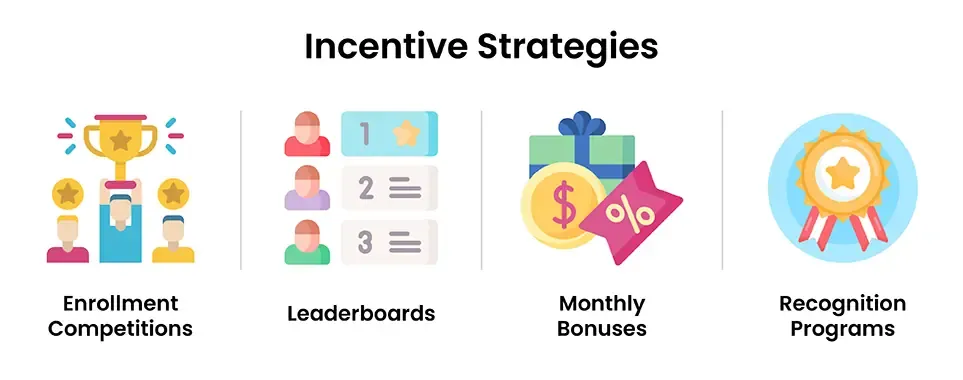
Incentive Strategies
- Enrollment Competitions: A well-run competition can inject a surge of energy. Keep them short and focused. A week-long contest to see who can get the most enrollments is far more effective than a month-long marathon.
- Leaderboards: Visual, public tracking taps into our natural competitive instincts. A simple whiteboard in the back room showing the weekly leaders can be a powerful motivator. It turns a company goal into a personal one.
- Monthly Bonuses: A tangible reward for top performers goes a long way. This could be a gift card, a prime parking spot for a month, or a cash bonus in their next paycheck. It signals that their effort is valued.
- Recognition Programs: Never underestimate the power of public praise. Acknowledging a team member’s success in a team meeting or a company-wide email can be just as motivating as a small bonus. It fulfills a fundamental human need to be seen and appreciated.
Performance Metrics to Track
To know if your training and motivation are working, you need to look at the right data. Don’t just look at total enrollments; dig deeper to understand the story behind the numbers.
- Enrollment Rate per Employee: This is your primary metric. It shows you who your champions are and who might need additional coaching.
- Conversion Rate: How many customers who are asked actually sign up? A low conversion rate might indicate a problem with the script or the offer itself.
- Redemption Errors: Are customers having trouble using their rewards? A high number of errors at the register points to a breakdown in training around the redemption process. Staff need to know where customers redeem their tokens—the Swag Shop is a key redemption channel.
- Customer Feedback: Are customers mentioning the program in reviews or surveys? Positive feedback is a win; negative feedback about staff not mentioning it is a red flag.
Conduct Ongoing Training & Optimization Regularly
A loyalty program is not a “set it and forget it” tool, and your training shouldn’t be either. The initial training session is just the foundation.

- Quarterly Refreshers: The human brain is designed to be forgotten. Schedule short, 15-minute refresher sessions every few months to keep the program top-of-mind. Use this time to celebrate wins and revisit objection handling.
- Update Training When Rules Change: This seems obvious, but it’s a common mistake. If you change a redemption threshold or add a new perk, you must immediately update your training materials and communicate the change to your team. Nothing erodes customer trust faster than an employee giving them outdated information.
- Collect Employee Feedback: Your staff are on the front lines. They hear every customer’s objection firsthand. Create a simple, anonymous way for them to share feedback on the script, the program rules, or the sign-up process. They are your best source of intelligence for improvement.
- Improve Script Messaging: Use the feedback you gather to refine your messaging. If you notice a particular objection is coming up repeatedly, work with your team to craft a better, more authentic response to it. The script should be a living document.
Similar Read: Proven Strategies to Re-Engage Members
Common Staff Training Mistakes (and How to Avoid Them)
Even with the best intentions, training can go wrong. Here are some of the most common pitfalls and how to steer clear of them.
- Mistake: Ignoring Redemption Process Training
- The Consequence: Employees know how to sign people up but freeze when a customer tries to use their points. This leads to frustrated customers and a perception that the program is a scam.
- Corrective Action: Spend as much time training on the redemption process as you do on enrollment. Every employee should be able to smoothly apply a reward to a purchase without fumbling or calling for a manager.
- Mistake: Treating Training as a One-Time Event
- The Consequence: Knowledge fades. Six months after launch, new hires are untrained, and veteran employees have forgotten the key messaging. The program’s enrollment rate plummets.
- Corrective Action: Treat training as an ongoing process. Integrate loyalty program metrics into regular team meetings and build it into your standard onboarding for all new hires.
- Mistake: Overloading Staff with Technical Details
- The Consequence: Employees’ eyes glaze over. They become overwhelmed by the “how” of the backend system and lose focus on the “why” of customer conversation.
- Corrective Action: Keep the training focused on the customer interaction. Explain the backend only as it relates to the front-end process.
- Mistake: Not Measuring Staff Understanding
- The Consequence: You assume everyone knows what they’re doing, but the data tells a different story.
- Corrective Action: Use a simple certification process to identify training gaps and improve performance.
- Mistake: Failing to Align Incentives
- The Consequence: Staff see the program as extra work with no personal benefit.
- Corrective Action: Introduce incentives. Even small rewards can motivate staff. For multi-store businesses, Umbrella Loyalty helps track incentives across locations.
- Mistake: Not Updating Training After Program Changes
- The Consequence: Mismatch between what staff say and what system does, causing confusion.
- Corrective Action: Always update training materials and inform staff immediately after any program change.

- The Consequence: You end up with a two-tiered team: the original crew who know the program and a growing group of new hires who are completely in the dark. This dilutes the program’s effectiveness over time.
- Corrective Action: Integrate loyalty program training into your standard new-hire onboarding checklist. It should be as fundamental as learning how to open a register or greet a customer. A new hire should never be left to “figure it out” on their own.
Conclusion
Here’s what we want you to take away.
Your loyalty program is only as strong as the people delivering it. You can spend thousands on software. You can design the perfect points structure. You can integrate with every system under the sun. And if your cashier mumbles “uh, do you want to sign up for something” while staring at the screen, it’s all wasted.
Training isn’t a checkbox. It’s a revenue multiplier. When your staff understand the program, believe in its value, and know exactly what to say, enrollment goes up. Redemptions go up. Customer retention goes up.
But it doesn’t happen by accident. It happens by design. Structured training. Clear expectations. Ongoing reinforcement. Real incentives.
Start there. Build from that foundation. And watch your loyalty program actually deliver what you promised.

FAQs
Initial training typically takes 60-90 minutes for existing staff. This covers the why, the how, and hands-on practice. New hire training should include a condensed 30-minute module as part of onboarding. Refreshers every quarter take about 20 minutes.
They need to know four things: how customers enroll, how they earn, how they redeem, and what's in it for the customer. Everything else is optional. Master those four and they're effective.
Because the program lives or dies at the point of interaction. Customers don't read manuals. They don't explore the app on their own. They learn from your staff. If staff can't explain it, customers won't use it.
Incentives, recognition, and making it easy. Give them a target. Celebrate when they hit it. Provide scripts so they don't have to invent words. Remove friction from the enrollment process. When it's easy and rewarding, they'll do it.
Make it part of day-one onboarding. Let them practice in a test environment, then watch them interact with real customers before they’re on their own. That way, they learn by doing—and start off confident.
Treating it as a one-time event. Overloading staff with irrelevant details. Not measuring understanding. Failing to update training when the program changes. Forgetting to train new hires. Ignoring redemption training. All fixable. All costly if ignored.
Posted on Mar 12, 2026

Danielle is a content writer at Loyal-n-Save. She specializes in writing about implementing loyalty solutions proven to help a company grow.
Content Writer