


Preventing Loyalty Program Fraud and Abuse: Merchant Best Practices

Loyalty programs have become non-negotiable engines for growth in retail and ecommerce. They are the frontline of customer retention. But as their value skyrockets, they attract a new enemy: sophisticated fraudsters and opportunistic customers who see your program not as a reward system but as a vulnerable target.
This is not a minor leak. This is a direct assault on your profitability. Criminals execute loyalty program fraud through account takeovers, draining hard-earned rewards from your best customers. They exploit sign-up bonuses with fake identities. They manipulate promotions never intended for their use. Internally, without the right safeguards, even employee misuse can drain your resources.
This is the reality of modern loyalty fraud. Ignoring it is not an option. Tolerating it actively subsidizes your own losses. This article covers loyalty fraud detection and the architecture of loyalty fraud prevention.
- Secure your program
- Protect your revenue
- Command your platform
What Is Loyalty Program Fraud?

Loyalty program fraud is a systematic attack on the financial integrity of your rewards ecosystem. It is any deliberate, malicious activity designed to illegitimately acquire, manipulate, or redeem the coupons, discounts, and perks you offer. The scope is your entire customer journey, from the moment of sign-up to the final redemption.
Fraudsters target every vulnerability:
- The Onboarding Gate: Fake sign-ups and synthetic identities to harvest welcome bonuses.
- The Reward Reservoir: Account takeover (ATO) to loot accumulated coupons/rewards from legitimate members.
- The Promotion Engine: Exploiting coupon codes and offers through bots or coordinated groups.
- The Redemption Gate: Illegitimately converting stolen rewards into goods, gift cards, or services.
Understand this core truth: your loyalty rewards are a digital currency. They hold real monetary value. Customers trade them for products. They exchange gift cards. They purchase experiences. This perceived value is what makes your program powerful, and it is precisely what makes it a target. Loyalty fraud is not a petty crime; it is the theft of cash from your balance sheet.
Why Is Loyalty Fraud on the Rise?
It is quite simple. Look at the image below:

Image Courtesy: Fortune Business Insights
It is obvious that the larger the loyalty market, the more opportunities for fraud arise.
Besides this, there are three powerful forces converging to create a perfect storm for loyalty fraud. This is not a random chance. It is the direct result of our digital evolution.
First, the automation and cross-channel access we built for customer convenience have become a fraudster’s weapon. Application programming interfaces (APIs) and connected systems allow attacks to be executed at a scale and speed impossible for human teams to manually detect.
Second, the epidemic of third-party data breaches has armed criminals with a massive inventory of validated customer credentials. They deploy these in automated loyalty fraud detection attacks, testing stolen emails and passwords against your login portal. Every data breach elsewhere becomes a potential security test for your program.
Third, and most critically, merchants themselves have raised stakes. Richer rewards, exclusive perks, and high-value discounts have transformed programs into lucrative targets. The higher the value of your digital currency, the more incentive criminals have to attack it. You built a powerful rewards engine. Fraudsters now see it as a vault to be cracked.
The escalation is logical. Your defense must be equally logical, moving beyond simple monitoring to active loyalty fraud prevention.
How Does Loyalty Fraud Affect Your Business?
Loyalty fraud is not a line item. It is a systemic infection that attacks the core of your operation. It creates a cascade of failures that drain revenue, erode trust, and cripple your ability to make intelligent decisions. Every illegitimate point redeemed is a direct hit to your profitability and a data point that corrupts your view of the customer.
The consequences are measured in seven critical areas of business damage:
| Impact Area | The Direct Consequence |
|---|---|
| Revenue Loss | You exchange real goods and services for stolen or fraudulently acquired rewards. This is not a discount; it is a gift to criminals. |
| Brand Damage | Legitimate customers whose accounts are drained will lose faith in your ability to protect them. Their loyalty is betrayed by your vulnerability. |
| Operational Costs | Your team wastes countless hours manually investigating suspicious activity, resetting passwords, and placating angry customers instead of driving growth. |
| Inventory Shrinkage | High-value inventory disappears to fulfill redemptions from fraudulent accounts, creating stock-outs that punish your real customers. |
| Discrepancy in Reconciliation | Your financial reporting becomes unreliable. Point liability on the books no longer matches reality, making it impossible to forecast accurately. |
| Reduction in Participation | When customers see a program as insecure or unfair, they disengage. They will not invest their spending into a system they do not trust. |
| Inaccurate Analytics Data | Loyalty fraud detection becomes nearly impossible when fake accounts and fraudulent transactions poison your customer data. You end up optimizing your business for thieves. |
Types of Loyalty Program Fraud & How They Will Happen
Understanding the specific methods of attack is the first step in building your defense.
Here is how common loyalty fraud schemes operate and where your vulnerabilities lie:
1. Account Takeover Fraud
This is a direct assault on your members. Criminals use stolen credentials to breach customer accounts, executing a swift loyalty fraud attack to drain accumulated rewards and redeem them for high-value items.
2. Fake Account Creation
Fraudsters deploy bots to fabricate identities en masse, exploiting your welcome bonuses. This widespread loyalty program fraud depletes your marketing budget and corrupts your customer database from day one.
3. Transaction Manipulation
This method twists your policies against you. Fraudsters exploit returns or claim to illegitimately earn or keep points, creating a significant challenge for loyalty fraud detection in your transaction logs.
4. Fraudulent Receipt Uploads
Criminals use basic editing tools to forge proof of purchase, submitting fake receipts to claim rewards. This type of loyalty program fraud directly targets the integrity of your receipt-scanning promotions.
5. Referral Collusion
Attackers create networks of fake accounts that refer to each other in a closed loop. This systematic abuse of your referral program is a coordinated loyalty fraud operation that skews marketing data and drains your point pool.
6. Coupon Code Abuse
This involves mass scraping and unauthorized use of discount codes. Bots test countless combinations, leading to widespread revenue loss. Forcing loyalty fraud prevention is an essential parameter in your promotional campaigns.
9 Best Practices to Prevent Loyalty Program Fraud

Your loyalty program is a valuable asset. These nine strategic practices form an integrated defense system for comprehensive loyalty fraud prevention. Deploy them to secure your points, protect your revenue, and maintain customer trust.
1. Ban Suspicious Customers from Store
Take direct action against identified threats. The LNS backend gives you the command to immediately ban suspicious accounts from participating in your program, neutralizing repeat offenders and securing your perimeter.
2. Setting Notifications Up
Activate your early warning system. Configure the LNS platform to send instant alerts when customers exceed a set number of purchases or point redemptions within a 24-hour period. This real-time loyalty fraud detection allows you to investigate anomalies before significant damage occurs.
3. Tighten Redemption Controls
Fortify the point where points become currency. Implement strict rules around how and when rewards can be cashed in.
| Control Tactic | How It Stops Fraud |
|---|---|
| Limit Gift Card/Cash Redemptions | Make high-value, easily liquidated rewards a privileged tier. This drastically reduces the immediate monetary incentive for loyalty program fraud. |
| Tier-Based Redemption Access | Restrict premium rewards to your most proven customers. Fraudsters with new accounts cannot access your most valuable inventory. |
| Set Rules for Redemption | Use LNS to enforce a mandatory interval between redemptions. This creates a cooling-off period that disrupts rapid-point-draining attacks. |
4. Regular Report Audit
Command your data. Schedule timely audits of your loyalty reports. Scrutinize discount accrual and redemption patterns. This disciplined habit is fundamental to loyalty fraud detection, revealing hidden schemes that real-time tools might miss.
5. Strengthen Identity Verification & Account Creation Security
Secure the gates to your program. Make every entry point a checkpoint.
- Email & Mobile OTP Verification: Confirm a real person owns the contact details provided.
- Device Fingerprinting: Identify and flag connections from devices known for suspicious activity.
- In-Progress (IP) Monitoring & Geo-Tracking: Block traffic from high-risk locations and detect impossible travel logins.
- CAPTCHA & Bot Protection: Stop automated scripts from mass-creating fake accounts.
6. Enhance Customer Account Security
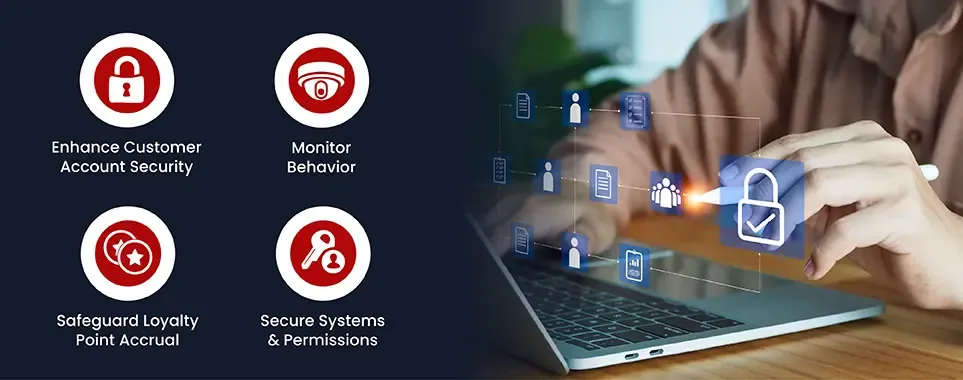
Protect your members’ digital wallets. Their account security is your security.
- Multi-Factor Authentication (MFA): Make account takeover significantly harder for criminals.
- Strong Password Policies: Enforce complex passwords to resist brute-force attacks.
- Login Attempt Rate-Limiting: Freeze out bots that try to guess passwords through repeated attempts.
- Session Timeout Settings: Automatically log out idle users to prevent access from unattended devices.
7. Monitor Behavior with Fraud Detection Tools
Deploy your intelligence network. Use advanced tools to automatically flag suspicious patterns.
- Real-Time Anomaly Detection: Identify and block transactions that deviate from a customer’s normal behavior.
- Velocity Controls: Flag impossible point-earning or spending speeds.
- Machine Learning Models: Leverage algorithms that continuously learn and adapt to new loyalty fraud tactics.
8. Safeguard Loyalty Point Accrual
Control the faucet. Preventing fraudulent point accumulation is the most effective form of loyalty fraud prevention.
- Set Earning Caps: Place a hard limit on points that can be earned from a single transaction or within a day.
- Validate Transaction Data: At checkout, ensure points are awarded to a verified customer. Use the FTx Identity Queue for secure ID scan verification, or validate via phone, email, or a loyalty card QR code. This links points to a legitimate, identified person.
9. Secure Internal Systems & Employee Permissions
Protect your command center. The greatest threat can sometimes come from within.
- Role-Based Access Control (RBAC): Grant employees the required level of system access needed to perform their jobs. Not everyone needs admin rights.
- Audit Logs for All Loyalty Actions: Maintain detailed records. Use LNS store and employee reports to track which employee processed a sale, awarded points, or issued a refund, creating full accountability.
- Employee Training & Awareness: Educate your team on the signs of loyalty program fraud and the critical role they play in preventing it.
Implement these commands. Build your fortress. Your program’s integrity—and your profit—depend on it.
Wrapping Up
The battlefield of loyalty fraud does not remain static. As your program grows in value, the attacks against it will grow in sophistication. A reactive stance is a losing strategy. Your defense must be unbreakable, proactive, and constantly evolving.
Success comes from a layered approach. Deploy advanced technology for loyalty fraud detection. Engineer strict controls for loyalty fraud prevention. Maintain relentless monitoring. This triad—technology, controls, and vigilance—forms the fortress that protects your revenue and your brand’s integrity.
This is not a one-time deployment. It is a continuous campaign. Command your strategy by regularly auditing and updating your program’s policies and security protocols. Stay ahead of the threats. Secure your assets.
Build a loyalty program that rewards customers, not criminals. That is the final objective. Now go execute.

FAQs
Loyalty points have evolved into a universal digital currency. They hold real monetary value that can be converted into goods, gift cards, and services. As programs have become more valuable and interconnected, they present a high-reward, low-risk target for criminals compared to traditional financial systems.
All businesses with valuable rewards are targets. However, those with high-frequency transactions (grocery, convenience), high-ticket items (electronics, apparel), and digital gift cards are particularly attractive. Any merchant without a layered defense is vulnerable, regardless of size.
It is a dual-front assault. External, sophisticated hackers execute organized loyalty fraud through automation and data breaches. Simultaneously, internal 'friendly fraud' from opportunistic customers exploiting weak policy enforcement contributes significantly to losses. You must defend against both threats.
Absolutely. Modern platforms like LNS are built with scalable security. Features like redemption limits, notification alerts, and basic velocity checks are not luxuries—they are essential controls. Every business, from day one, can and must deploy these foundational loyalty fraud prevention tools.
Protect the sign-up process with multiple layers of verification. Require email or mobile one-time password (OTP) validation and use CAPTCHA challenges to block automated bots. These measures help stop fake account creation before it starts.
Posted on Dec 8, 2025

Danielle is a content writer at Loyal-n-Save. She specializes in writing about implementing loyalty solutions proven to help a company grow.
Content Writer